

Credit unions have built their identity around the cooperative difference, but a national study from Gallup raises a challenging question: Does that differentiation live in members’ minds or mostly within credit unions?
Gallup polled 2,000 banked U.S. adults and found only 17.8% said banks and credit unions were truly different. In a joint webinar hosted by Callahan & Associates and Gallup, experts explore what these findings could mean for credit union growth strategies.
Watch the webinar today, and read on for key takeaways.
Trust Is A Driver, Values Are Not
When asked why they choose a financial institution, trust emerged as the top factor among consumers. But trust can exist on a spectrum. At its most basic level, it indicates confidence that an institution will safeguard consumers’ money. At its highest level, it indicates confidence that an institution will protect their future.
At the same time, values resonated the least. Consumers generally recognize that credit unions are community-minded and values-driven. However, those attributes alone aren’t compelling enough to switch to a credit union.
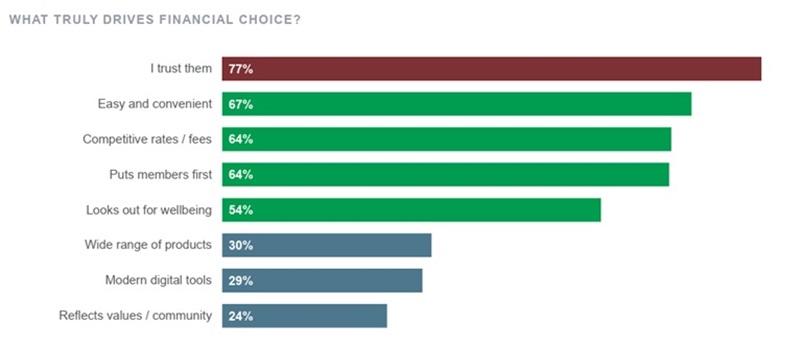
In Gallup research, consumers most often cite trust as the primary reason they choose or stay with a financial institution, followed by ease, rates, and member-first practices. Scores reflect the relative importance of each factor when respondents make trade-offs.
Credit unions often talk about service, rates, and community involvement. Presenters in this webinar suggest credit unions can stand out more by positioning themselves as trusted advisors that help members navigate major financial decisions and improve their lives over time.
The Financial Wellbeing Support Trifecta
Gallup identified three experiences that together form what presenters called the “financial wellbeing support trifecta.”
Those elements are:
- Channel Consistency — Ensuring members experience seamless, reliable service in every channel and smooth transitions when they switch between them.
- Digital Empowerment — Empowering members to transact and interact how they want, when they want, and make it simple and easy for daily banking.
- Anticipate Needs — Moving from reactive to proactive by better understanding where members are in their personal journey and what they might need next.
Among these, anticipating needs emerged as the biggest opportunity. Only one in five credit union members strongly agreed that their institution proactively anticipated their financial needs. When all three elements were present, engagement levels surged dramatically.
Consumers Aren’t Unhappy, They’re Comfortable
When Gallup asked non-credit union members why they weren’t using a credit union, the dominant response wasn’t distrust, dissatisfaction, or concerns about technology. Most respondents said they were simply happy where they were.
People have their paycheck set up through direct deposit. Their bills are set to autopay. Their debit card is saved in dozens of online accounts. Even if they aren’t deeply engaged with their current institution, the relationship is functional enough that switching feels like more trouble than it’s worth.
Although the industry often frames its competitors as large banks or fintechs, Gallup’s research suggests the bigger obstacle might simply be the status quo. Experts on the webinar encourage credit union leaders to proactively demonstrate why a deeper, more supportive financial relationship is worth making a change rather than relying on dissatisfaction to drive consumers to consider one.
A Persistent Generational Gap
When looking at consumer attitudes by generation, Gallup research revealed a significant awareness gap among young adults.
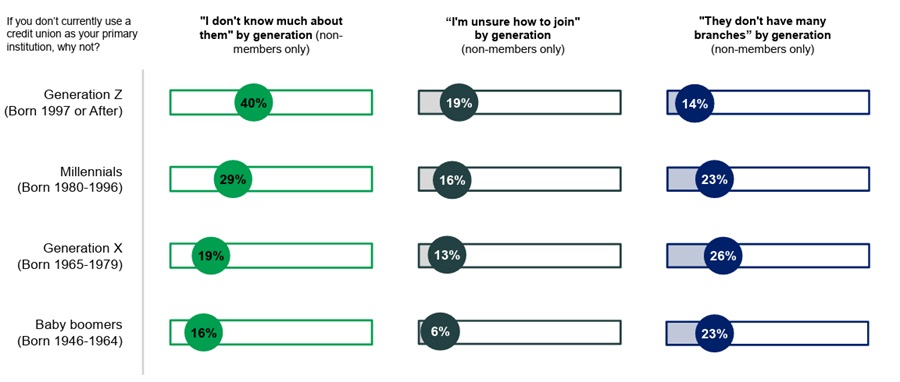
In Gallup research, lack of awareness emerges as a key barrier, with younger consumers more likely to say they don’t know much about credit unions or how to join. Scores reflect the share of non-members in each generation who cited each reason.
Gen Z was the least likely to perceive differences between banks and credit unions and more likely to be unsure how membership even works. At the same time, these respondents placed somewhat greater importance on values and community alignment than older generations.
The generation most receptive to purpose-driven organizations is also the generation least familiar with them. Presenters highlighted more modern messaging that meets young consumers where they are as one way to help close that gap.
So What’s Next?
Gallup data presents clear implications for how credit unions approach growth, from member acquisition to investment strategy.
Through the Member Engagement & Financial Wellbeing Consortium, Callahan and Gallup help credit unions measure what matters, act with confidence, and build stronger member relationships that fuel growth.